Riluminati – Innovation for building monitoring
What is the Riluminati crack luminescence method?
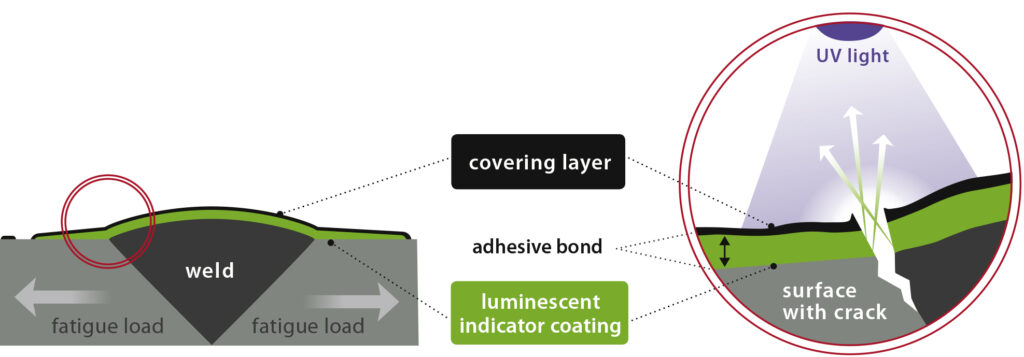
Riluminati refers to a specially developed coating system that makes it particularly easy to monitor crack formation and growth over the long term. Developed at the Federal Institute for Materials Research and Testing by Dr. Milad Mehdianpour in cooperation with MR Chemie GmbH, the system consists of two coordinated coatings: the fluorescent indicator coating Riluminati 815 and the black top coat Riluminati 816. Together, they form the basis for the innovative monitoring process.
How the crack luminescence method works
The application is straightforward: after thorough cleaning, the indicator coating is applied first, followed by the top coat – similar to conventional painting. If a crack occurs during operation, the coating also cracks. Under UV light, the indicator coating glows at the crack sites – a clear signal for inspectors. The inspection is carried out either manually using a UV lamp or automatically using a camera and image analysis.
Comparison with conventional testing methods
Conventional methods such as the penetration method or the magnetic particle testing method provide reliable snapshots of the material condition. However, if monitoring is to be carried out over longer periods of time, these tests must be repeated regularly. They require trained personnel, access to the component, and, in some cases, interruptions to operations. Continuous monitoring using conventional methods therefore involves considerable effort and expense.
In contrast, the Riluminati coating remains permanently on the component and enables inspections to be carried out while it is installed – in some cases even during operation. This saves time, reduces downtime, and lowers maintenance costs. Crack monitoring thus becomes more flexible, more efficient, and easier to integrate into digital processes and cloud-based AI systems.
You are currently viewing a placeholder content from YouTube. To access the actual content, click the button below. Please note that doing so will share data with third-party providers.
More InformationExample based on a model
Advantages: Durability and modern monitoring
- Long-term monitoring: Permanent monitoring without the need for re-preparation or removal of the component.
- Easy handling: Application is straightforward, and evaluation of the light effect does not require expensive special measurement technology.
- Inspection during operation: Inspections can be carried out flexibly during work breaks or even during operation – even in hard-to-reach places.
High compatibility with AI and cloud services: The optical data is ideal for automated evaluation, cloud-based monitoring, and online research.
Practical examples from industry
The Riluminati process has already proven itself in a wide range of industries, for example in:
- Wind turbines
- Rail sector
- Material and dynamic test benches
- Gantry cranes
- DiMoWind-Inspect research project
Cracks can be detected at an early stage, especially in critical areas such as the weld seams of gantry cranes. Maintenance measures can thus be carried out as needed rather than according to a fixed schedule. The automation of inspection with drones and UV cameras is also possible and ideal for integration into digital inspection systems.
Innovation potential: Combination with digital processes and AI
While classic methods such as acoustic emission sensor technology only locate cracks but do not make them visible, the Riluminati method complements them perfectly. If the sensor technology detects abnormalities, Riluminati provides visual evidence. In the future, artificial intelligence will be able to automate the evaluation of image data, filter out interference, and categorize crack indications. This transforms a manual inspection method into a true SHM (structural health monitoring) system for modern infrastructure.
Limitations and recommendations
Riluminati is suitable for steel and aluminum components. To date, no reliable function has been demonstrated for components made of copper or magnesium. Under optimal conditions, the coating has a service life of at least three years. Since the system does not offer corrosion protection, it is recommended for use on low-corrosion components or in protected environments.
Conclusion and outlook
Riluminati is an innovative process that closes the gap between spot checks and continuous monitoring. It simplifies crack monitoring, saves resources, and offers great potential for integration into automated, cloud-based inspection systems. In combination with digital technologies and artificial intelligence, the crack luminescence process could play a key role in the maintenance of modern infrastructure in the future.