Old machines, new challenges
In times of sustainability, raw material shortages, and increasing individualization, there is a growing need to keep existing machines— some of which are decades old—in working order. Particularly in industry,where many special-purpose machines, custom-made products, or imported devicesare used, problems arise when spare parts are no longer available for certain components.Original drawings are missing, installation space data is not available, and standard components do not fit.
Here, two modern technologies come together to offer an exceptionally powerful solution: optical 3D measurement technology for the digital capture of real components and additive manufacturing (3D printing) for the rapid production of individual components. This article uses a concrete practical example—a 70-year-old This article uses a concrete practical example—a 70-year-old machine—to show how these technologies solve real problems and why this approach can be applied to almost any industry.
Recognizing the problem: No replacement, no drawing
Many older machines still function perfectly mechanically and are economically valuable to businesses. However, it is often small details that make continued operation difficult or impossible. In our practical example, this is the PTO shaft of a 70-year-old vintage tractor. The PTO shaft drives attached implements by transferring power from the engine to the implement via the shaft. When not in use, the PTO shaft stub is exposed, allowing dust and dirt to enter the transmission through porous seals. Potential damage is inevitable.
The catch: there are no spare parts. The machine manufacturer no longer exists. Drawings cannot be found. The component must therefore be accurately and reliably captured, redesigned, and functionally replaced—without interrupting machine operation in the long term. This is exactly where the combination of optical 3D capture and additive manufacturing comes in.
Digitization as a basis: 3D scanning creates the digital twin
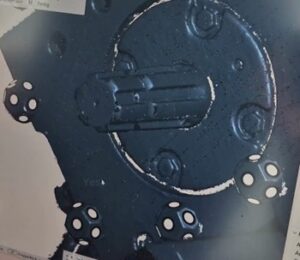
Optical 3D measurement technology is used to accurately capture the geometry of the shaft and the surrounding threaded holes. The machine area is scanned on site so that a digital twin of the real situation can be created.
Our 3D scanning spray from MR Chemie GmbH is used for better, easier, and faster data acquisition. It creates a temporary matte, reflection-free surface, resulting in significantly more precise measurement results.
Digitization is performed using a high-resolution laser scanner from Scantech, model Simscan-E. The data is evaluated and processed using Quick Surface software.
The result is a highly detailed point cloud or mesh model that is transferred directly to the CAD environment.
From scan to idea: CAD design of an intelligent solution
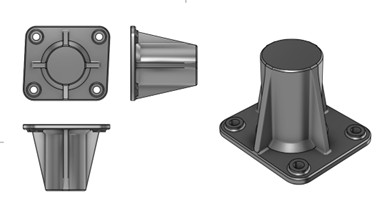
The actual development work begins with the digital geometry of the installation space: Vision Center GmbH, a company specializing in reverse engineering and digital product development, uses the scan data to design a protective cover that fits the existing structure perfectly.
Design objectives:
- Precise sealing without interfering with the original part
- Reusable solution with secure hold
- Weather-resistant, impact-resistant, and easy to install
- Manufacturing optimized with 3D printing: without support structures, with defined wall thicknesses
In the CAD environment, the new cover is positioned directly in relation to the shaft. The model can then be virtually tested, optimized, and adapted to the machine area.
Additive manufacturing: Data becomes function
The next step is to manufacture the solution—and this is where additive manufacturing really comes into its own:
- No molds or tools necessary
- High material diversity (e.g., temperature-resistant or chemical-resistant plastics)
- Short turnaround time – often less than 24 hours
- Iterative optimization made easy
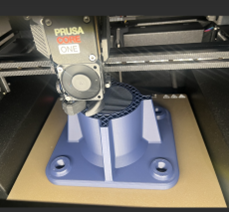
The CAD model is exported as an STL file and prepared for 3D printing in the slicer. The appropriate material and printer are selected depending on the requirements.
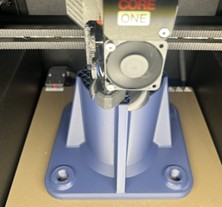
In this case, the component was printed from PLA using a Prusa Core One.
Montage und Praxisnachweis
The finished cover is installed directly on site. Thanks to precise digitization, it fits perfectly—no reworking is necessary. In practice, it quickly becomes apparent that:
- No dirt ingress via the porous seal
- No unnecessary strain or modification of the existing machine
- Quick disassembly possible when using the PTO shaft
The measure extends the service life of a key component—with minimal effort.
Transferability to other machines and industries
Das Besondere: Dieser Prozess funktioniert branchen- und maschinenunabhängig. Ob Werkzeugmaschine, Oldtimer, Verpackungsanlage oder Fördertechnik – überall, wo alte Maschinen im Einsatz sind und Ersatzteile fehlen, kann dieser digitale Reparaturweg angewendet werden:
🔧 Beispiele aus der Praxis:
- Abdeckungen für offene Lagerstellen
- Nachbau von Guss- oder Blechteilen
- Dichtungsfassungen oder Schutzhauben
- Ersatzteile für Sonderanlagen
Statt einer langwierigen Suche oder Neuentwicklung wird ein funktionsfähiges Teil direkt am Original abgenommen, digital rekonstruiert und einsatzbereit gefertigt.
Vorteile des Ansatzes auf einen Blick
✅ Schnelle Problemlösung ohne Ausfallzeiten
✅ Keine Originalzeichnungen oder Herstellerdaten nötig
✅ Maßgenaue Passform durch optische 3D-Erfassung
✅ Geringe Kosten im Vergleich zu konventionellen Verfahren
✅ Sofort einsetzbar – lokal, nachhaltig und effizient
Zusammenarbeit: MR Chemie & Vision Center
Zwei Partner, ein Ziel: moderne Technologien zugänglich und praxisnah machen.
- MR Chemie GmbH stellt mit seinen 3D-Scanning Sprays die Grundlage für präzise optische Erfassung – besonders auf schwierigen Oberflächen.
- Vision Center GmbH bringt die Expertise in CAD, Reverse Engineering und additiver Fertigung – von der Digitalisierung über die Konstruktion bis zur Auslieferung der Lösung.
Die Zusammenarbeit dieser beiden Unternehmen zeigt, wie interdisziplinäre Projekte schnell, zielgerichtet und erfolgreich umgesetzt werden können – mit echtem Mehrwert für Anwender.

Fazit: Aus der Praxis für die Industrie
Optische 3D-Messtechnik in Kombination mit additiver Fertigung ist kein akademisches Zukunftsthema mehr. Es ist ein praxisbewährtes Werkzeug, um reale Probleme an bestehenden Maschinen wirtschaftlich und nachhaltig zu lösen.
Der Weg vom Problem zum funktionierenden Teil wird radikal verkürzt: Scannen. Konstruieren. Drucken. Einbauen. Fertig.
Ein modernes Werkzeug für klassische Maschinen – und ein starkes Signal für alle, die heute schon die industrielle Zukunft gestalten wollen.
Das gesamte Projekt in einer Video-Dokumentation ist über den folgenden Link zu finden.
Your contact

Mario Montalti
Sales Development Engineer Reflecon
0160 94750556
m.montalti@mr-chemie.de